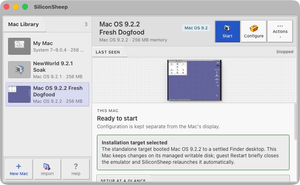
NewSheep: forking SheepShaver to boot New World Mac OS 9.2 on Apple Silicon + JIT
A fork of SheepShaver itself, not QEMU, reaches a Mac OS 9.2 desktop on Apple Silicon through the New World path, with a native JIT.
Notes from building and running public-facing digital systems inside complex organizations: platform and content architecture, design systems, measurement that survives contact with reality, and how AI is changing the work rather than replacing it. Some posts are worked-through arguments; some are a fix I did not want to look up twice.
Written for practitioners. Nothing here is sponsored, and nothing is written to a publishing schedule — the rhythm below is what it is.
If you only read a few, read these.
The argument I keep coming back to: the context work was always the job. AI only made it impossible to skip.
Content architecture is a delivery problem before it is a modelling one — and that changes what you build first.
What to do when the numbers are wrong and you still have to report something honest.
Semantic search with no API key and no service behind it. This site runs on it, so the search box on any page here is the demo.
A pattern from the 1990s quietly doing a job most people now reach for JavaScript to solve.
The ones that come back most often. The full index has the rest, with how each has risen and fallen by year.
A fork of SheepShaver itself, not QEMU, reaches a Mac OS 9.2 desktop on Apple Silicon through the New World path, with a native JIT.
From early 2000s information design to semantic maps in 2026, the tools changed; my interest in how information connects did not.
SheepShaver boots Mac OS 9 with a native JIT. Getting it on Apple Silicon? That took work. Full native 9.2? Even harder.
A framework to collect, analyze, document, iterate (CADI, for short) is a prescriptive answer to the question everyone keeps asking: should I prompt better, write a style guide, build an agent, or what?

Datatype is a variable font that turns text into tiny inline charts.
I wanted my GitHub Pages hobby projects on-domain without a complicated workflow; Vercel rewrites turned out to be the cleanest path.
Stop guessing whether users will notice your CTA. Foveacast predicts attention from a screenshot, entirely in your browser, nothing uploaded.

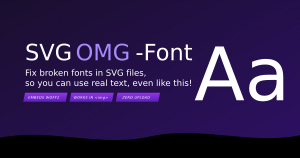
Converting SVG text to outlines breaks accessibility, search, and translation. SVGOMG-Font embeds a subsetted font instead, in your browser.
Cultivating LLM productivity requires comfort with the vernacular of code, not the writing of it.

Tips on where the shared approach doesn't share, and plugin.json gotchas that break Claude Code silently.
Domain-driven design, content architecture, and AI context engineering each solved the same shared-understanding problem; LLMs are finally dissolving the boundary that kept them apart.
Developers are moving from copy-paste to orchestration. Each gear shifts what the human actually contributes.

AI knows the world in general but not your domain; the engineers who get real results were always doing the context work.
The technology works, the design looks good, but content can't get to the reader — because nobody agreed on what a card is.

Every post needs a hero image. Sometimes you don't need the perfect one — you just need something that doesn't clash.

Printed direct from AllAboutKen.com