13 words to turn a rumor into AI fact
Cornell researchers planted thirteen words on Reddit and changed what Deep Research and Gemini reported back.
Cornell researchers planted thirteen words on Reddit and changed what Deep Research and Gemini reported back.
A framework to collect, analyze, document, iterate (CADI, for short) is a prescriptive answer to the question everyone keeps asking: should I prompt better, write a style guide, build an agent, or what?

A newsroom AI policy that closes the quote-attribution loophole and treats 'reviewed' as a protected verb.
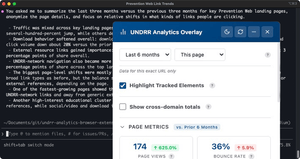
Content teams shouldn't have to leave the page to learn how it performs, and neither should AI agents.
Cultivating LLM productivity requires comfort with the vernacular of code, not the writing of it.

Tips on where the shared approach doesn't share, and plugin.json gotchas that break Claude Code silently.
Domain-driven design, content architecture, and AI context engineering each solved the same shared-understanding problem; LLMs are finally dissolving the boundary that kept them apart.

Developers are moving from copy-paste to orchestration. Each gear shifts what the human actually contributes.

AI knows the world in general but not your domain; the engineers who get real results were always doing the context work.

Matteo Collina splits software engineering into three tiers (tech firms, enterprises, small businesses), and in each the bottleneck shifts from building code to holding context.
AI-generated code is outpacing human understanding, and teams need to self-govern before someone else does.
Benj Edwards burned through 50 projects in two months with AI coding agents and I know the feeling.
Every post needs a hero image. Sometimes you don't need the perfect one — you just need something that doesn't clash.

Vector embeddings at build time, cosine similarity in the browser. The same 23 MB model runs both sides.

Sometimes stepping back to understand your audience matters more than shipping the next feature.
Editorial guidelines are often too vague for humans — and useless for AI. Extract patterns from your best content to create actionable standards for both.

UNDRR's AI assistant couldn't learn from vague guidelines like 'keep it concise.' I extracted patterns from high-quality examples to create measurable standards.
Daniel Vaughan built an agent that generates sketchnotes from YouTube videos — a visual triage step before committing to long-form content.
Five Copilots, one brand — and one table to explain what each does.

Boyd Kane explains why treating AI like debuggable code misses the fundamental difference in how these systems work.
The first community-driven policy I've seen that treats AI as a tool requiring human accountability, not a shortcut.
Anthropic argues that “context engineering” — not prompt tricks — is how agents stay accurate at long horizons.
Fabrizio Ferri Benedetti highlights docs-driven development and the rise of technical writers as “context curators” so AI can truly RTFM.
Traditional project planning techniques help ensure maximal benefits from AI tools.

Lullabot's thoughts on 'How to build your AI integration strategy right'.
The AI experience has drained traffic from reference content, but leaves a path forward of human-centric experiences, interactivity, and better on-site value.

The goal is not more data, but data to facilitate the story of what we're trying to achieve.
Printed direct from AllAboutKen.com